The HSBC Women’s World Championship strives to engage and inspire communities in Singapore and the wider Asia region through the game of golf.
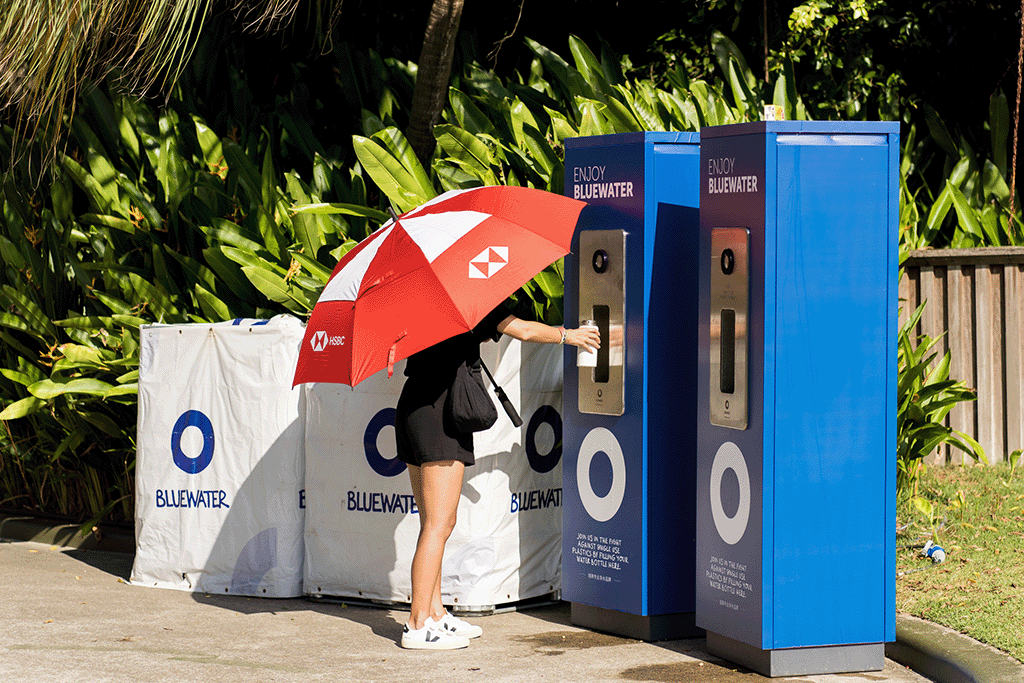
The championship is committed to delivering world-class golf responsibly, with meaningful sustainability initiatives integrated across the tournament experience. From expanded water refill stations that helped eliminate over 66,000 single-use plastic bottles, to digital tools that reduced printed materials, every effort was made to minimise environmental impact.
Fans and participants also engaged with sustainability through thoughtful activations, including upcycling initiatives within the community and educational programmes highlighting biodiversity at Sentosa Golf Club. Across the venue, reusable materials, recycling systems, and responsibly sourced food and beverage options reinforced our ongoing commitment to reducing waste and promoting a more sustainable future for sport.
Our tournament partners also share the same sustainability with us. Swipe through to read more on each tournament partner.
Sentosa Golf Club is widely regarded as the world’s most sustainable golf club. The Club launched its first sustainability campaign, #KeepitGreen, back at the 2018 SMBC Singapore Open, which was designed to raise awareness for participation within golf in Singapore and also sustainable practices within the sport.
A number of environmental initiatives have since been pioneered by the Club, via the #KeepitGreen umbrella (which has since become a way of life and mantra at the Club), all geared towards helping the Club become more sustainable and reduce its carbon footprint.
1. Banning all single-use plastics from the course saving over 150,000 plastic bottles a year
2. Creating six bee colonies to help increase worldwide population
3. Moving to single head control irrigation system has reduced the Club’s water resources by up to 40%
4. Purchasing GPS spraying equipment to increase efficiency and reduce product application use by 30%
5. Installing food and horticultural waste digesters – helping to save an estimate 30% on monthly waste disposal over a one-year period
6. Activating five Electric Vehicle (EV) Charging Stations through a partnership with Porsche Destination Charging
The Club continued to build on its goals and ambitions set out with #KeepitGreen, launching a second sustainability campaign, called GAME ON, in 2020. The campaign has since urged the golf industry to respond to climate change by implement new modern processes for the betterment of the environment. In 2020, Sentosa became the first golf club in the world to join the United Nations Sports for Climate Action Initiative. The following year, at the HSBC Women’s World Championship, the Club also committed to becoming the world’s first carbon neutral golf club.
Awards:
1. Club named ‘World’s Best Eco-Friendly Golf Facility’ for third consecutive year at World Golf Awards in 2022
2. Club ranked 75th in Platinum Clubs of the World Top 100 Golf & Country Clubs 2022-23
3. The Tanjong – ranked #3 in Singapore for Golf Digest’s Best Courses in Every Country list 2022-23
Sustainability at the heart of our journey
Over the years, Singapore Airlines has had a long-standing commitment to sustainability. Recognising the importance of sustainability in building a resilient and responsible business, we integrate key environmental, social, and governance principles into our strategic decisions and business operations.
As a leader in the industry, we operate one of the youngest fleets in the world, comprising technologically advanced and fuel-efficient models such as Airbus’ A350 and A320 Family, as well as Boeing’s 787 Family and 737-8s. This helps us reduce our carbon emissions at the source in an effective manner. In 2021, we pledged our commitment to achieve net zero carbon emissions by 2050. Apart from investments in new generation aircrafts, we actively pursue multiple levers to decarbonise. These include improving operational efficiencies, advancing the adoption of sustainable aviation fuels, and sourcing for high quality carbon offsets.
We are empowering both our customers and cargo partners to play a part too, through our voluntary carbon offset programme. Contributions from customers would help to protect forests in Indonesia, support renewable solar energy projects in India, and provide efficient, clean burning cookstoves for rural families in Nepal.
We continue to partner various stakeholders in our sustainability journey to jointly create a positive impact on the environment and communities where we operate in.
Please click here to learn more about our sustainability efforts.
Marina Bay Sands operates with the highest commitment to reduce its environmental impact, with goals in Energy, Waste, Water, Resource Management, Sustainable Procurement, and Biodiversity. It has an ambitious global commitment to the Science Based Targets Initiative pledging to reduce Las Vegas Sands’ greenhouse gas emissions by 17.5% by 2025. Since 2012, the integrated resort has lowered its overall carbon footprint by over 50%, decoupling its environmental impact from business growth.
For more information, please visit marinabaysands.com/sustainability
The Road to net-zero: Aon’s commitment for emissions by 2030
Aon is committed to reducing the environmental impact of its operations and to becoming a more resilient, sustainable organization by achieving net-zero greenhouse gas emissions by 2030 in alignment with Science-Based Targets.
“We believe this is a necessary step to take as a global corporate citizen to ensure we are doing our part to reduce our carbon footprint and help mitigate the significant catastrophic impacts of climate change,” said Greg Case, CEO of Aon.
To achieve this goal, Aon’s efforts will focus on four key areas:
- Reducing Environmental Impact in Operations and Facilities
- Taking Action Toward Sustainable Sourcing
- Transitioning to Renewable Energy
- Prioritizing Virtual Gatherings to Reduce Travel
Please click here to learn more.
Little steps, lots of drops
Walking on less water, changing the tanning game
You’ve probably never thought about how much water it takes to produce one full piece of uncut leather. We have. That’s why ECCO developed DriTan™. The first step towards water-efficient leather manufacturing and a game-changing innovation for the leather industry.
The craft of leather-tanning has been around for thousands of years. And it was always thought to be impossible without using large amounts of water – a resource more precious now than ever.
At ECCO, we were determined to find a different way. A better way. So after five years of research and testing, the ECCO Leather Applied Research team in the Netherlands did exactly that.
They developed a unique process that doesn’t need any additional water to make one full piece of ECCO DriTan™ leather. Saving 20 litres of water – around 400,000 drops – along the way.
On top of that, DriTan™ lowers our wastewater volumes and reduces the volume of chemicals used – in 2021 we saved 260 tonnes. In all our tanneries, we have always treated our own wastewater onsite. Our goal? Net zero water discharge by 2030.
We’re proud of the quality, durability, versatility and natural texture of ECCO DriTan™ leather. And because of the potential water-saving impact, ECCO has made DriTan™ technology open to share with other leather tanneries. A positive impact on the whole leather industry, not just at ECCO.
A small but mighty step to preserving more of our most precious resource. Because we care.
Epson leverages efficient, compact, and precision technologies that are in its DNA to help transform the way our customers work. Within the office environment, Epson technology helps enhance productivity and communication, reduces long work hours, supports flexible work arrangements, and saves energy and paper resources.
Epson wants to be known as a company that’s committed to sustainability. As part of Epson’s core, Sustainability runs through everything we do: in the way we work, in the solutions that drive our customers’ businesses forward and in the initiatives that contributes to our communities.
Make the sustainable choice with fast, eco-efficient business printers
Sustainability at the core
Epson is committed to meeting 14 out of the 17 Sustainable Development Goals (SDGs) through its technology development, environmental and CSR initiatives. Epson’s Environmental Vision 2050 is aligned with the SDGs. We will continue to address customer and societal challenges and create unique environmental value through our business activities to help achieve the SDGs and a sustainable future.
Revolutionary inkjet innovation
Energy Efficient:
Up to 85% less CO2 generated vs laser printers
Annual CO2 output calculations were based on JEMAI-LCA Pro. Cedar tree CO2 absorption calculations were based on Japan Forestry Agency standards of 8.8kg CO2 per annum per tree.
Heat-free ink ejection:
Up to 85% less power consumption vs laser printers
Statistics above are based on results from internal testing conducted by Epson, using Epson L6550 ISO Color 12ipm vs Laser model ISO Color 22ppm test for power consumed to print 20 pages. Testing single page A4 document of ISO Office Final PDF (ISO/IEC 24734). Each test was conducted twice by Epson to ensure consistency of results. Both printers have been tested under same conditions.
High-capacity consumables:
Up to 59% less replacement parts vs laser printers
Statistics above are based on results from internal testing conducted by Epson. Comparison models were selected from among the top-selling 50% of A4 color laser printers (21-30ppm class) listed in IDC Worldwide Quarterly Hardcopy Peripherals Tracker 2019Q3 data CY2018Q4-CY2019Q3 results. The volume of consumables and replacement parts needed to print 200K pages was calculated by Epson based on yields published by the manufacture for each model. Quoted yields are stimulated figures calculated by Epson based on ISO/IEC24712 methodology.
Make the switch at www.epson.com.sg/becool
Our unwavering commitment to ESG principles serves as the cornerstone of our efforts to create a positive and lasting impact on our community and environment. Through strategic collaborations and substantial investments, we have made significant strides in supporting disadvantaged individuals, empowering youth, enhancing the well-being of seniors, and fostering community engagement.
We have helped and committed to uplift disadvantaged families and individuals across 32 charities and organisations with donations of more than US$1 million annually. As we move forward, we remain steadfast in our mission to drive meaningful change and contribute to a better, more inclusive future for all.
At Lexus, we believe that true luxury moves in harmony with the world around it. Since the launch of the RX 400h in 2005, we have pursued dynamic performance through electrified technologies. Today, this philosophy continues to live on with our ambition to achieve carbon neutrality by 2050.
Central to this vision is our electrification strategy and our global commitment to offer 100% Battery Electric Vehicle (BEV) models by 2035. Through electrification, our vehicles are being reimagined from the ground up – from dedicated BEV platforms and advanced battery systems to thoughtfully selected sustainable materials. Every element is engineered to shape the future of mobility responsibly, while elevating the modern luxury lifestyle through innovation, comfort and craftsmanship.
This journey comes to life through the Lexus RZ, our first dedicated BEV, and the all-new Lexus ES, redesigned with a fully electrified powertrain line-up. Together, they represent our progress toward a more sustainable future by leading the next era of electrification.
Hilton Singapore Orchard takes mindful steps to embrace sustainability in daily operations and in every step of the guest journey to reduce its environmental footprint.
These include being the first hotel in Singapore to have an in-house custom-built water filtration plant and bottling system that purifies and bottles up to 500 bottles of drinking water in reusable glass bottles. This eliminates over 1.2 million single-use platic bottles annually across the 1,080-room hotel. The hotel also installed automated in-room motion, air-conditioning and light sensors in all rooms to conserve energy; has bulk bath amenities in guest rooms and uses Forest Stewardship Council- (FSC) certified wooden key cards to reduce single-use plastics; use FSC-certified or recycled paper sourced from sustainably managed forests for paper products; practise responsible food and seafood sourcing, employ digital communication to replace physical communication materials; have a garden-to-table concept at Californian-Italian restaurant Osteria Mozza; and more.
As part of Hilton’s Meet with Purpose programme, Hilton Singapore Orchard also offers meeting and event planners an option for Carbon Neutral Meetings and provide attendees with opportunities to gather sustainably through means such as measuring and managing their environmental performance and creating sustainable menus.
A testament to its commitment to sustainability, the hotel has achieved the Global Sustainable Tourism Council Certification (GSTC) in October 2024. This is a globally recognized certification of the hotel’s commitment in ensuring effective sustainability planning, maximizing social and economic benefits for the local community, and reduction of negative impacts to the environment.
Click here for more information on Hilton Singapore Orchard’s sustainability efforts.